
Health
Emerado Volunteer Fire Department extinguishes 2-acre fire
By Amina El-Amin
Advertisement · Why this ad?
Lydia Smallwood is a seasoned journalist with a degree in Business Communication from the University of Minnesota. With six years of writing for local publications and a focus on small businesses, she brings stories of innovation and resilience to the forefront.
More from Lydia →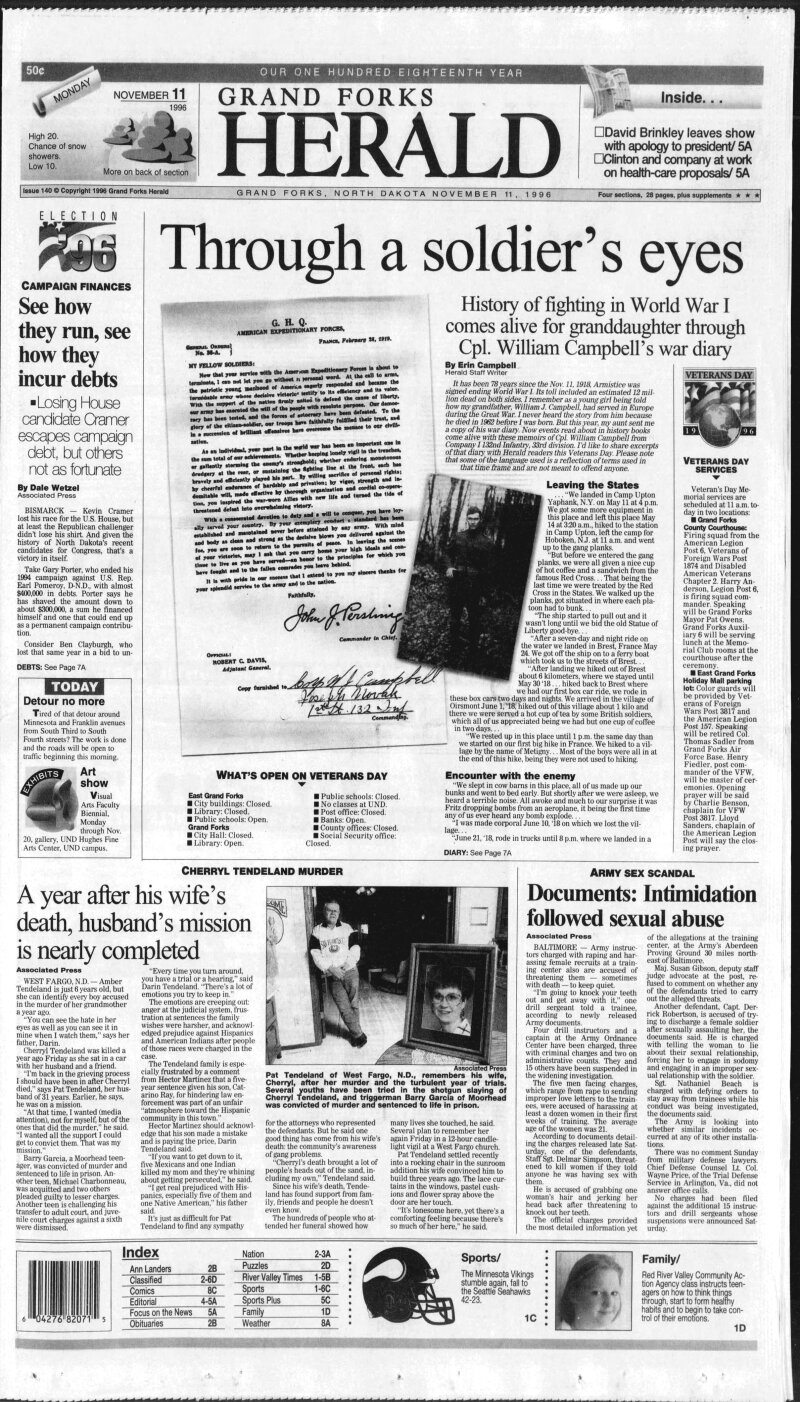
The scent of woodsmoke and the echo of marching boots – these are the sensations that leap from the pages of a diary, penned nearly a century ago by a young Grand Forks man fighting in the trenches of World War I. Cpl. William J. Campbell’s account, recently shared by his granddaughter, Erin Campbell, offers a visceral glimpse into the horrors and hardships faced by American soldiers during the Great War. It’s a story of courage, loss, and the enduring human spirit, brought to life for a new generation as we mark the 122nd anniversary of the Armistice – Nov. 11, 1918 – that brought an end to the conflict that reshaped the world. U.S. Army Armistice Day remembers this day as a solemn moment of reflection.
Campbell’s granddaughter, also a reporter, discovered the diary after her aunt sent it to her. It provided a profound connection to a grandfather she never knew, and a powerful reminder of the sacrifices made by countless Americans. The diary entries, spanning from May 1918 to October 1918, detail his journey from Camp Upton in New York to the front lines in France, and the brutal realities of trench warfare. Campbell’s words, raw and unfiltered, offer a perspective far more intimate than any history textbook could provide.
The timing of this discovery is particularly poignant. As we remember the estimated 12 million deaths on both sides of the conflict, Campbell’s diary serves as a stark reminder of the human cost of war. The young corporal’s observations, his fears, and his camaraderie with fellow soldiers paint a vivid picture of a generation forged in the crucible of battle. World War One Centennial is a valuable resource for learning more about this pivotal moment in history.
Campbell's journey began with a bittersweet departure from the United States. “But before we entered the gang planks, we were all given a nice cup of hot coffee and a sandwich from the famous Red Cross ... That being the last time we were treated by the Red Cross in the States,” he wrote, capturing a moment of simple kindness amidst the looming uncertainty of war. His arrival in France was followed by grueling marches and boxcar rides, punctuated by moments of respite and unexpected kindness, like the tea offered by British soldiers after a particularly arduous hike. “We rested up in this place until 1 p.m. the same day than we started on our first big hike in France,” he recounted.
The diary entries chronicle the escalating intensity of the fighting, from the initial shock of enemy bombing raids to the brutal reality of no-man’s-land. The July 4th capture of 1,800 prisoners by his regiment stands as a testament to the courage and resilience of the American soldiers. But amidst the victories, Campbell also documented the profound losses – the fallen comrades, the shattered landscapes, and the ever-present threat of death. “Every now and then a comrade would fall by side, being hit by the Boche machine gun bullet,” he wrote, a chilling reminder of the constant peril.
One particularly harrowing entry detailed a sniper encounter on Dead Man’s Hill, where Campbell and a fellow corporal risked their lives to gain a strategic advantage. “As we went to cross this hill at one point the Huns' snipers opened fire on us,” he wrote, describing the desperate scramble for cover and the precariousness of their mission. The diary also recounts a devastating gas attack in October 1918, where Campbell’s company suffered heavy casualties. “Company I went into this place with 206 men strong on Oct. 6 and came out Oct. 13 with 36 men,” he documented, a stark illustration of the war's relentless toll.
Campbell’s language, reflective of the era, underscores the historical context of his experiences. While some terms may be jarring to modern ears, his granddaughter notes that they are presented as a window into the past, not as endorsements of any particular viewpoint. The diary’s power lies in its ability to transport readers to the front lines, allowing them to experience the war through the eyes of an ordinary soldier grappling with extraordinary circumstances.
Campbell’s account also reveals interactions with Allied forces, including the Australians. “Mid-August: The Australians had driven the Boche back and many German bodies were still lying on the field. We found many of the Germans' rifles they had left behind and some of their grenades ... At 5:30 p.m. we left this place to go to the front lines to help the Australians,” he wrote. He described the Australian soldiers as being “very glad to see us come to give them aid as they sure were in a bad position.” A reconnaissance mission led Campbell and another corporal to Dead Man’s Hill, where they discovered a hidden observation post with a powerful scope, allowing them to observe German positions. “We gained much information from this point.”
The diary entries paint a grim picture of the devastating effects of gas attacks. “On the morning of Sept. 20 we had a gas attack by the Boche. They shot over 268 shells in 48 minutes, most of them were high explosive shells with gas,” Campbell wrote. The October gas attack was particularly brutal, with Company I suffering heavy losses. “Early October: As we entered these woods of Bois-De-Faire, you could see bodies laying nearly everywhere. And as we entered the woods we got gassed and we kept shooting over gas and high explosive shells. Company I went into this place with 206 men strong on Oct. 6 and came out Oct. 13 with 36 men. Many men from Company I got gassed on Oct. 8, '18. The Huns shot over gas for 24 hours ... As we walk quietly along the shells would burst and knock down large trees and we were gassed on our way out of this patrol. We walked past many of our dying comrades, we could do nothing to help them. Many would cry out 'tell mother I will not come back'.”
The language used in the diary, while reflective of the time, is presented with a crucial caveat: “Please note that some of the language used is a reflection of terms used in that time frame and are not meant to offend anyone.” This acknowledgment underscores the importance of understanding historical context when engaging with primary sources. The diary’s value lies not only in its historical details but also in its ability to humanize the experience of war, reminding us of the individual sacrifices made by those who served.
The discovery of Cpl. Campbell’s diary is a reminder that history is not just something that happens in textbooks; it’s a living, breathing narrative that continues to unfold through the stories of individuals. It’s a story of courage, sacrifice, and the enduring human spirit – a story that deserves to be told and retold for generations to come. William J. Campbell Memorial Hall often commemorate the sacrifices of veterans.
Lydia's Take
Reading Cpl. Campbell’s diary is a sobering experience. It’s easy to abstractly understand the scale of World War I – the millions of casualties, the redrawn maps, the shifting global power dynamics. But Campbell’s words bring it all into sharp, heartbreaking focus. The sheer exhaustion, the constant fear, the loss of comrades – it's a burden almost unimaginable to those of us who have never known such hardship. It makes me think about the importance of strong families and communities in providing support and stability, especially during times of crisis. When men and women are deployed overseas, their families at home face their own battles, carrying the weight of worry and uncertainty. We need to be mindful of the sacrifices made not just by those in uniform, but by those who wait for their return. The commitment to marriage and family is a bedrock of a resilient society; it's a foundation that can weather any storm.
What lingers most from Campbell’s account is the simple humanity shining through the darkness. The Red Cross coffee, the kindness of the British soldiers, the shared camaraderie – these small acts of grace offer a glimmer of hope amidst the devastation. It reminds us that even in the midst of unimaginable suffering, the human spirit can endure and even flourish. As we reflect on this anniversary, let us remember not only the fallen but also the enduring strength and resilience of those who carry on – the families, the communities, and the nation that they serve. The Grand Forks community has a long tradition of supporting veterans; Grand Forks Chamber of Commerce often highlights local businesses that employ veterans.
Going forward, it’s vital that we continue to preserve and share these personal accounts of history. They offer a unique and invaluable perspective that cannot be found in textbooks or official documents. Erin Campbell’s decision to share her grandfather’s diary is a powerful example of how we can connect with the past and honor the sacrifices of those who served. Let us all strive to be better stewards of our history, ensuring that future generations understand the true cost of freedom and the importance of peace. The Department of Veterans Affairs provides resources and support for veterans and their families.
The diary’s publication has sparked a renewed interest in local history within Grand Forks, prompting many residents to explore their own family connections to the war. The story serves as a reminder that even seemingly ordinary individuals can play an extraordinary role in shaping history. It also highlights the importance of preserving personal documents and artifacts, as they offer a unique and irreplaceable window into the past. It's a lesson for all of us to document our own lives, so that future generations can understand the context of our times.
The diary’s language, while reflective of the era, also provides a glimpse into the evolving social norms and attitudes of the time. While some terms may be considered offensive today, understanding their historical context is crucial for accurately interpreting Campbell’s experiences. Erin Campbell’s thoughtful introduction acknowledges this sensitivity and encourages readers to approach the diary with an open mind and a willingness to learn. It’s a testament to the power of education and the importance of confronting difficult truths about our past.
The discovery of Cpl. William Campbell’s diary is a reminder that history is not just something that happens in textbooks; it’s a living, breathing narrative that continues to unfold through the stories of individuals. It’s a story of courage, sacrifice, and the enduring human spirit – a story that deserves to be told and retold for generations to come. The American Red Cross continues to provide vital support to military families.
Closing paragraph: The discovery of Cpl. William Campbell’s diary is a poignant reminder of the enduring power of personal stories to illuminate historical events. As we mark the 122nd anniversary of the Armistice, let us honor the memory of those who served and recommit ourselves to building a more peaceful world. The legacy of William J. Campbell's words will continue to resonate within our community, inspiring future generations to learn from the past and strive for a better future.
By Amina El-Amin

By Clara Jensen

By Lydia Smallwood

By Lydia Smallwood